

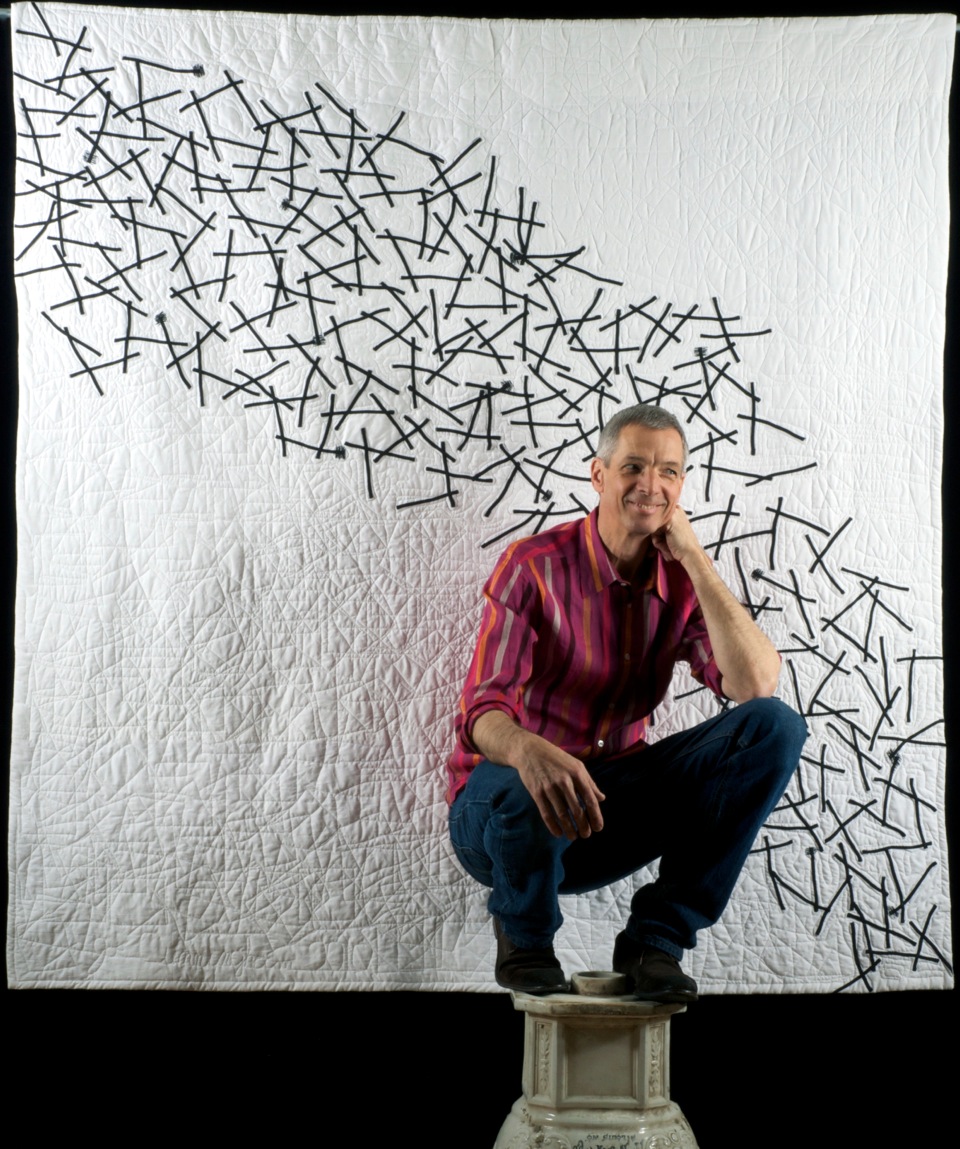
Joe Cunningham
Editor’s Note: Pro quilter, teacher, author and musician Joe Cunningham started quilting more than 30 years ago, when testosterone and quilting weren’t as common a combo as they now are. He’s a scholar and historian, using vintage and historic quilts as inspiration for his “totally Joe” style. His work hangs in museums and private collections and he’s graced the airwaves of PBS, HGTV and QNN. Oh, and he tours guilds and theaters with his musical quilt show, Joe The Quilter. Lucky us–and lucky you!–to get a glimpse of his artistic process. Enjoy!
By Joe Cunningham
I have long said that nearly every old quilt contains lessons upon which one could build a whole teaching career. That is what a lot of teachers of my generation did–take an idea from an old quilt, consider its implications and invent a new setting for it. We have ended up with all these teachers who specialize in one old technique or another, out of the possible catalogue of thousands or even hundreds of thousands. The quilts of 19th century America were made by women who were making up the tradition as they went along, each quilter empowered to do whatever she could think of, whatever suited her. So a lot of them have deeply original aspects that came and went with the original quiltmaker. When I am looking for ideas I often go back to the quilts of that period, before the advent of printed patterns and quilt judges, who intentionally or not, began enforcing conformity of techniques.
It might seem peculiar to look for new ideas by studying the old, but as a starting point for exploration, old quilts can’t be beat. It is like going to a land where thousands of techniques and concepts are just lying around on the ground waiting to be picked up and studied.

Quilts from the past often hold rich inspiration for modern quilters, such as the original hand piecing and quilting in this original quilt, c. 1950-1975, that was one of several vintage quilts in the Roderick Kiracofe exhibit at QuiltCon in Austin, Texas.
I ran into one the other day on Facebook, when Roderick Kiracofe posted one of the 10 quilts he was sending for a show at QuiltCon. Rod is one of my favorite people ever. I met him 30 years ago when we were both young guys in the middle of this gathering quilt hurricane, er, revival. He has always had a great eye for the unusual, the bold and creative. This particular quilt was of the type we call a “string” quilt, made by sewing a bunch of rough strips together to make a piece of fabric big enough from which to cut the pattern pieces.
It was made of a simple grid of six-inch squares, the first one a scrappy string block with the strings on a rough diagonal, and the next block made of a plain piece of printed fabric. By alternating the starting blocks of each row, the blocks lined up in diagonal lines across the quilt, pieced, plain, pieced, plain, etc. One further element in this quilt was that the plain blocks were made from a wide variety of fabrics. Put simply, every other block was either a pieced, strippy block or a plain scrap block. That’s it! But because of the unpredictability of the alternate plain blocks and the wackiness of the pieced blocks, the quilt had all kinds of energy and motion and…fun. It was just fun.
Now, it is my gift to you. Try it! I don’t want to post a picture, because I want everyone to have her own vision of this. You could start out with a whole large bunch of strips sewn together from which you could use a six-inch square and a rotary cutter to whack out dozens of blocks. Or you could piece chunks by hand and square them up with a pair of scissors.
Depending on the fabrics you started with, you could end up with a strikingly modern look, or a dark, Amish style, or a scrap quilt where the blocks all smeared into each other in a sort of watercolor wash. Like all my favorite ways of working, it is a process, not a pattern.

Another Kiracofe gem, this time a Spider Web variation (c. 1940-1970) from Hard Bargain, an African-American community in Franklin, Tennessee.
Speaking of process, this is one of the types of projects I’ll be teaching at my first quilt retreat in 20 years! I have long wanted to replicate the great experience I had co-conducting the first few retreats on Beaver Island, Michigan, in the 1980s, but have only now found the right place and the right team. My retreat partner is Patricia Belyea, whose enormous collection of yukata cotton fabrics from Japan would be perfect for the above quilt project.
The retreat will be Nov. 10-15 on the Hood Canal, a couple of hours west of Seattle at St Andrew’s House. Learn all about it here. It’ll be the high point of my year, a chance to spend five days with 30 quilters in a beautiful place, where no one has to cook, clean or drive. A place where the sewing machines can run all night long. And a place where I can teach the classes I want to teach, showing how simple processes can lead to rich results. With Patricia, maker of beautiful quilts, and a quilt frame set up in the lodge where we can relax and visit, it promises to be an experience to remember. (Plus part of the proceeds of the retreat will benefit the La Conner Quilt & Textile Museum.).
And hey, let me know how your old-cum-new quilt turns out! I love getting email and seeing pics of completed projects.
As Ever,
Joe


{ 1 comment… read it below or add one }
Oh boy, wouldn’t that be a wonderful retreat to attend?!?
I do like the idea of looking at old quilts to learn new things. Everything old is new again, as they say. Luckily, I do not believe in the quilt police either.