


A Cover Art Hanging Wallet
We’re thick into quilt show and vacation season here at GenQ and that means we want to pare down for the journey and bulk up (with the goodies) for the return. This little wallet will take you through the thick of any county fair or craft show with just enough pockets to hold the essentials. And what would those be, you ask? Well, the short list is: credit card(s), cash, ID, small note pad, pen, lipstick/gloss, business cards, emergency contact (for when you pass out in the aisles of Quilt Festival from the sight of all of those quilts!), car key and smart phone. And what we’ve given you here will hold all of that and just a little more, if you need to. But remember, true show tromping means you downsize so you can upsize your stash.
What we really love about this project is that it uses small bits of fabric and yet you’re able to embellish and decorate it however you wish.
The edge stitching and some of the other techniques used on the hanging wallet are adapted from Jake Finch’s book, Fast, Fun & Easy Book Cover Art, by C&T Publishing, 2007.
Finished sizes:
8” x 6” folded/finished
21” x 6” unfolded
Skill Level: Looks harder than it is.
Materials and tools:
___ Sense of Humor, some Patience and extra Imagination.
___ Sewing machine topstitch needles (bring at least two), size 80/12 and sharp needles, size 80/12. (I use Schmetz.)
___ Half-yard heavyweight interfacing like Fast2Fuse or Peltex.
___ Rotary cutter-medium or large.
___ Clear rotary ruler, 6” X 24” or 8” X 24”.
___ Ultra fine line permanent black and red markers such as Sharpie or Pigma.
___ Long pins for securing fabric for piecing.
___ 8” x 24” piece of thin batting: Use a cotton needle-punched batting, like Warm & Natural or Warm & White.
___ Half-yard lightweight fusible interfacing, prepackaged is fine.
___ Threads for piecing and decorative stitching. You will need about 500 yards of the edge thread. (I use solid colored rayon threads.)
___ (3) half-yard cuts of some wonderful, fabulous fabrics you love.
___ Optional embellishments: buttons, beads, trinkets and yarns.
___ Small can of spray baste. (I swear by 505 Spray and Fix.)
___ Applique Presser Sheet
Start with the inside first.
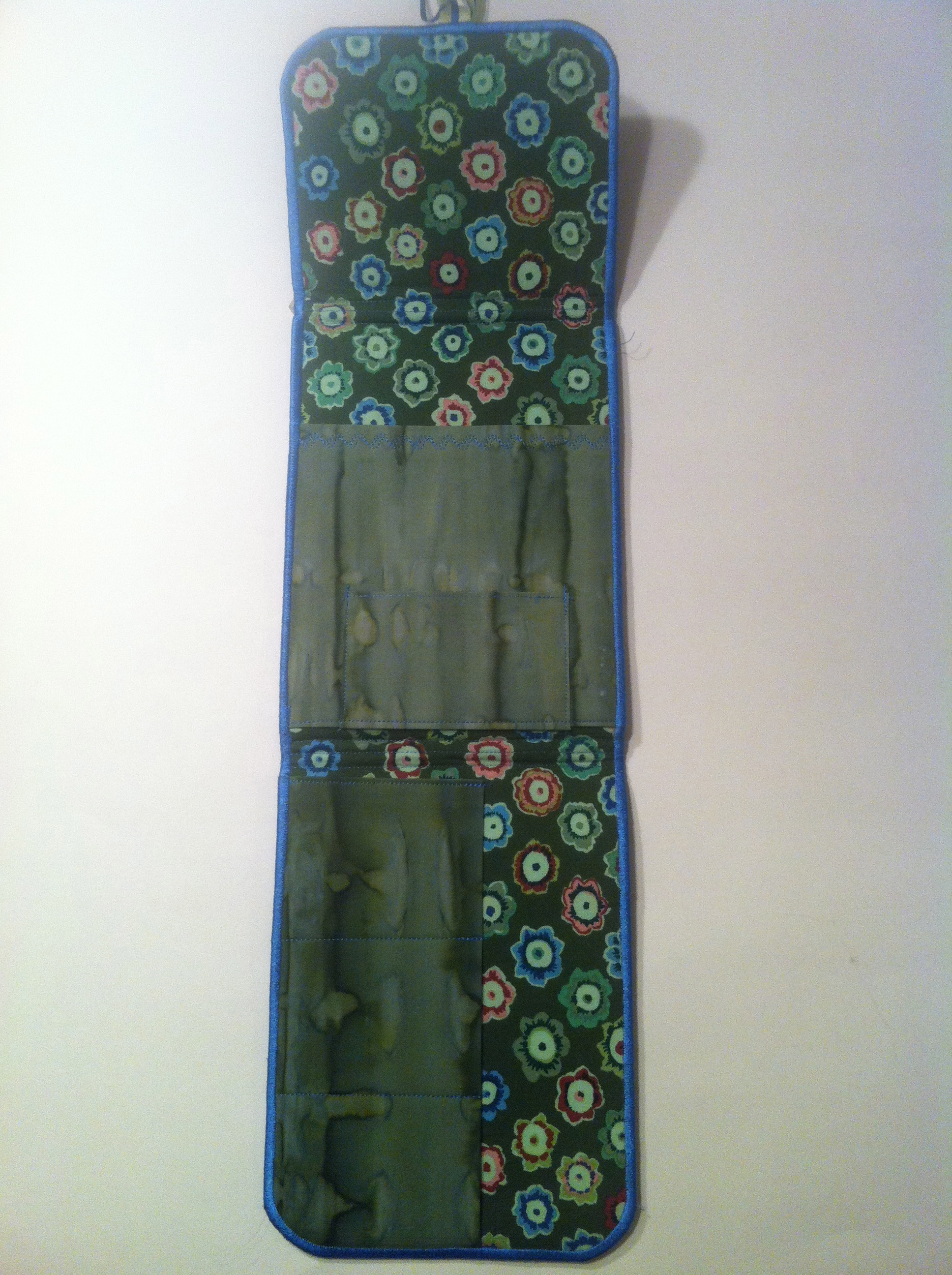
Inside the finished wallet
1. Cut Fast2Fuse at 21” x 6”.
2. Choose one fabric for wallet inside and cut piece to 22” x 7”.
3. Fuse fabric to one side of Fast2Fuse. Trim fabric to the edge of Fast2Fuse.
TIP: Fast2Fuse really loves steam and a hot iron. The iron needs to sit for a moment on the fabric to melt the fusible. Be patient.
Inside pockets.
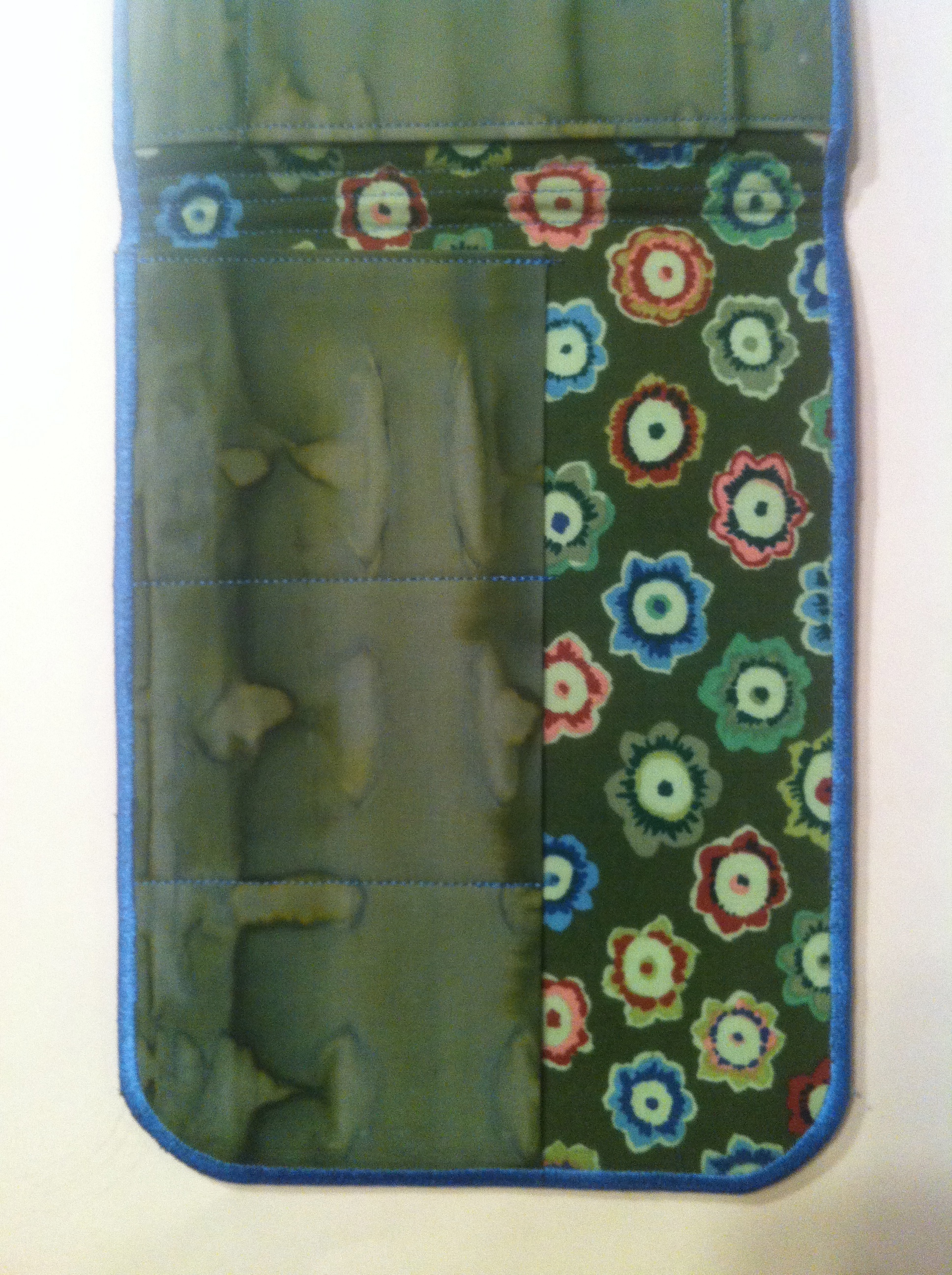
Card pockets
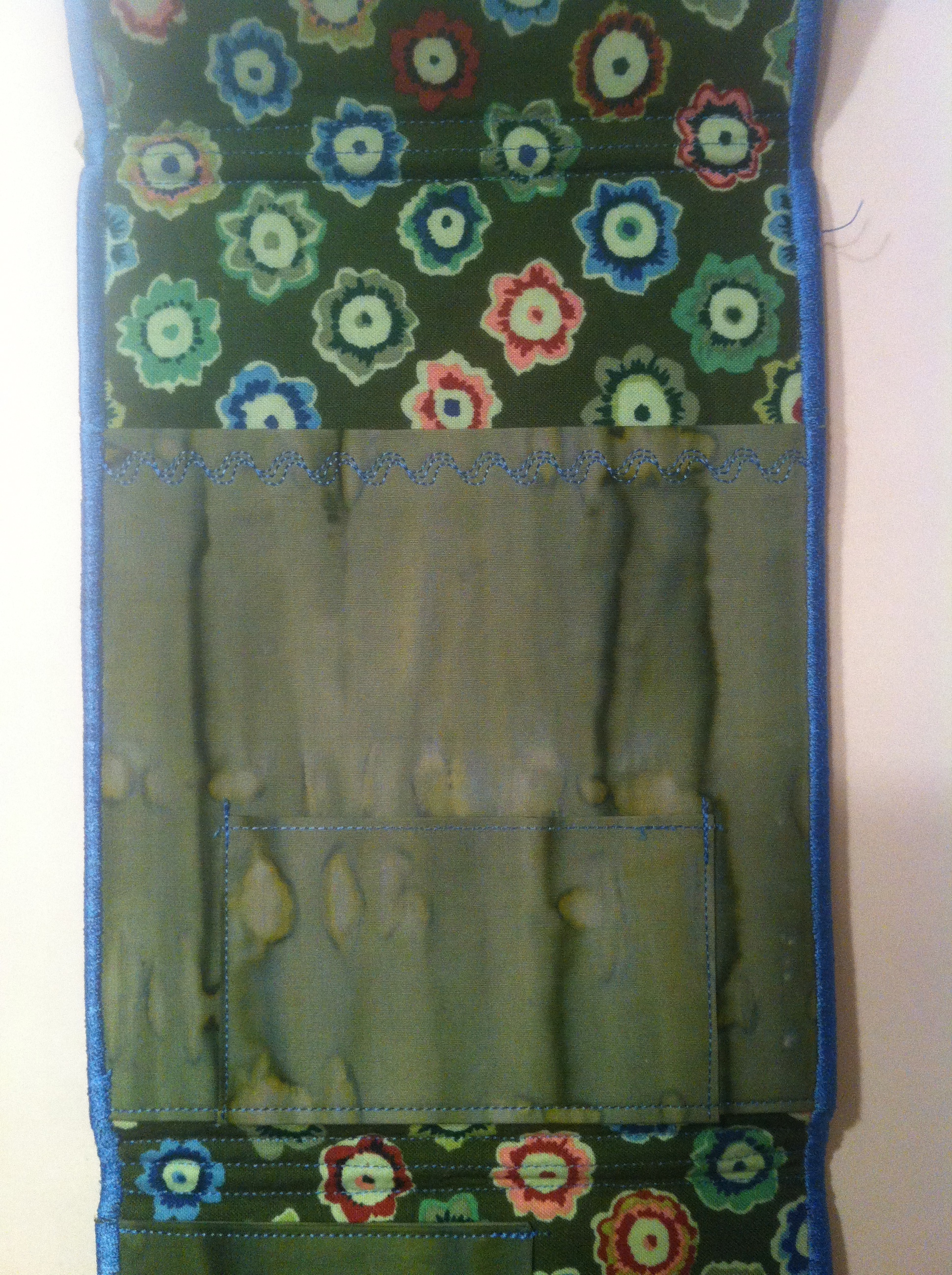
Middle pocket
1. Cut one pocket fabric at 12” x 6”. Cut a second pocket at 7 ½”” x 8”. The first pocket goes across the middle of the wallet. The second is the pocket that will hold cards.
2. For both pockets, cut matching pieces of lightweight interfacing. Fuse interfacing to wrong sides of each pocket. For middle pocket, fold in half across the 6” length, WST. Press. Topstitch ¼” from folded edge. Consider using a decorative stitch here. For card pocket, fold RST together along 7 ½” length. On one end, sew ¼” from raw edge. Turn pocket right sides out. Press seam flat and folded edge.
3. Before attaching pockets, folding lines need to be sewn into wallet. On raw side of Fast2Fuse, with a rotary ruler, from bottom, line up ruler against bottom line and mark 8” up, perpendicular to bottom line. Sew along this line. Then, sew parallel lines above and below this line, at ¼” away from center. These stitched lines enable the wallet to fold cleanly.
4. For second set of fold lines, measure up from the middle sewn line at 8”. At this point, repeat Step 3. There are now two sets of fold lines.
5. To attach middle pocket, draw parallel line ½” above the middle fold line on fabric side of Fast2Fuse. Then line up raw edge of middle pocket along the line and along outside edges, with folded edge pointed down to wallet’s bottom. Pin in place. Sew pocket to Fast2Fuse, ¼” from raw edge. Press pocket up along sewn line.
6. Pin in place along outside edges of wallet. Sew a basting stitch just inside wallet’s outer edge.
7. For card pocket, line up long raw edges evenly against one side and bottom edge of wallet in bottom section. Sew a basting stitch just inside both edges. Then, sew top finished edge of pocket. Sew two more lines, 2 ½” from top line and 2 ½” from sewn line. Set aside.
We’re on the outside now.
1. Cut a piece of batting and outside fabric at 22” x 7”. Spray baste, WST.
2. Embellish as desired.
TIP: Here’s where you can quilt, couch threads, bead, applique or whatever. If you want to use a pieced block. go for it. The point is to have fun.
3. You need to sew a button where the top edge of wallet folds down onto middle section. Marked and hand sew through batting on outside of fabric.
Outside pocket:

1. Cut fabric 10 ½” x 6 ½”.
2. Interface with lightweight fusible interfacing on wrong side of pocket fabric.
3. Fold in half, WST, on width, measuring 5 ¼” x 6 ½”.
4. Top stitch along folded edge. This is a good place to use a decorative stitch.
5. On right side of wallet outside, repeat Step 5 for inside pocket above.
Putting it all together:
1. Center Fast2Fuse inside on batting side of wallet outside. Spray baste together.
2. Trim edges of wallet outside flush to Fast2Fuse inside. Pin outside pocket in place along outer edges.
3. Using spool or some other small, round object, round each corner of wallet. Cut carefully.
4. Slip ribbons between layers on upper flap where it will be used to hold wallet closed at button and also along the sides of the flaps for the strap.
5. With same thread in top and bobbin, set machine to satin stitch. Begin stitching along outside edge. The left side of stitch will go into wallet. The right side of stitch will drop just off of the wallet. Make sure to hold ribbon(s) so they aren’t stitched down. Continue stitching around entire wallet, removing pins before you stitch them.
6. Trim loose threads and repeat satin stitching along outside edges.
Your wallet is ready to use!


{ 1 comment… read it below or add one }
It really is easier than it looks! But, then again, I had Jake right there to show me what to do…. ;^)
I did get mine almost finished in class & only had to do the edge stitching when I got home. Now it’s in the “these are for prezzies” box! Thanks Jake!!