

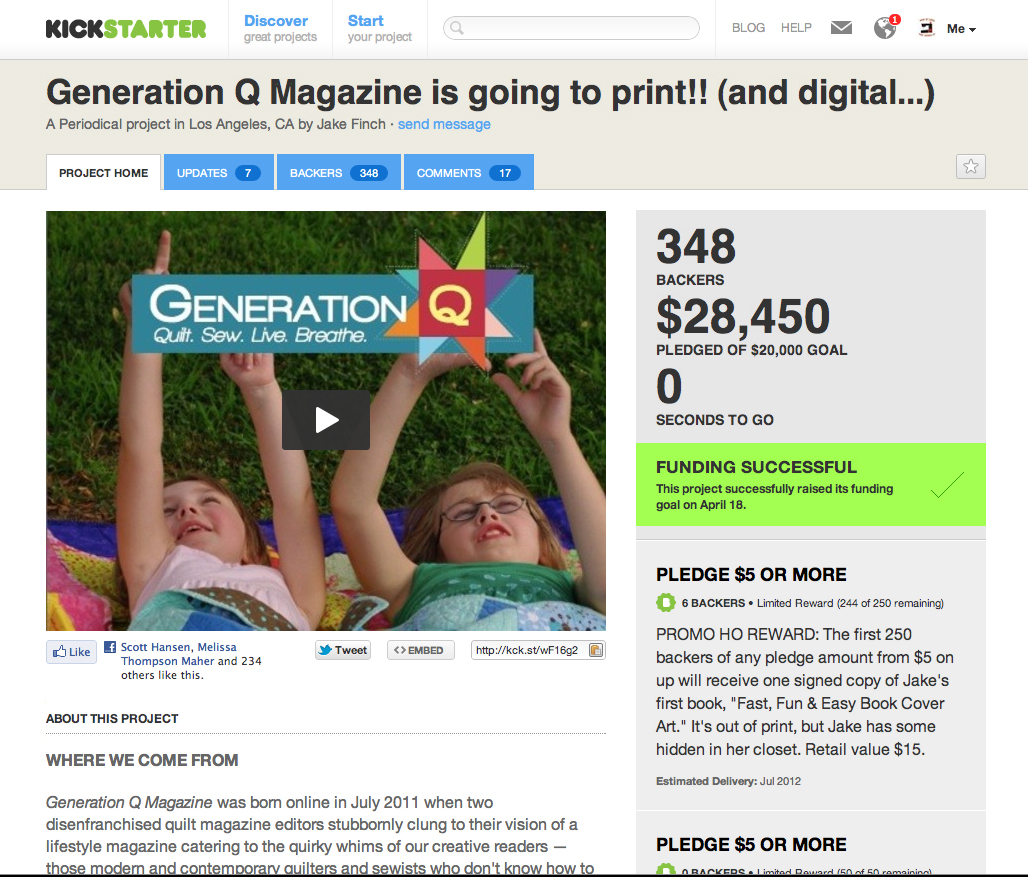
It was July 2011 and we were just about to launch our new online blogZine. We knew that this was the first big step on the way to becoming a print magazine and the start up funds needed to set up the website were very low—more sweat equity than cash.
As we closed in on launching our print edition of GenQ, we worried and wrestled with how to fund this next step. Used to working and living lean, we knew that in the scheme of start-up funds, we weren’t looking for a lot of dough. But, of course, a lot is a relative number. We looked into SBA loans, savings and the kindness of relatives, but nothing sat right.
We first heard about Kickstarter at International Quilt Market in Houston last October. We were open about the start-up funding needed to get our print issue out and several friends talked about how a fellow quilt designer had raised more than $6,000 on this new website for her pattern business. The money wasn’t a loan or charity and she didn’t need to sell her kidney to get it. Instead, she signed up with Kickstarter, produced a video of herself in action and reached out to friends, family and anyone else she knew.
We spoke to her and got some insight into the process, and then we found out that our hosts had also used Kickstarter to raise money for a documentary on the quilt biz they produced. We realized we were being shown the way.
We set to work planning our Kickstarter campaign. After some stops and starts, launched our campaign on February 29 (Leap Day). Our goal: Raise $20,000 in 47 days to fund the travel expenses to attend Spring Quilt Market and pay the printer for our first issue.
We made our goal in nine days.
 While we in no way expected to raise the money that fast, we knew we had a fighting shot because we really looked into the process before we started. Of course, succeeding as we did felt great and now we’re packing for Quilt Market.
We’re sharing some of the things we’ve learned about working on Kickstarter so that other budding entrepreneurs might benefit from our experiences. We love this business and believe that there is plenty of room for any and all creative stitchers who want to put out their talents to succeed. Kickstarter is a fantastic way to go, but you need to approach it correctly.
Kickstarter is an Internet company that calls itself “a crowd funding website for creative projects.” (Wikipedia) Projects are posted by individuals who present their business needs and goals on a webpage provided by Kickstarter. (Kickstarter approves every project before it’s posted to make sure it meets its guidelines, which are clearly explained here.)
A funding goal is set and a deadline is decided (up to 60 days) for the campaign. During that time, pledges are made to the project, but no money is actually collected until the campaign is finished. At that time, if the goal has been met or exceeded, the project receives the funding. If the goal falls short, there is no money collected.
If the goal is met, Amazon, (in a system similar to PayPal,) processes the credit card authorizations given them by the backers and the money is deposited into an Amazon account you set up. You then transfer the money into your bank account. If your campaign succeeds, Kickstarter takes 5 percent from every collected pledge. Amazon will take up to 5 percent as well. If the campaign fails, there are no charges.
Kickstarter has an excellent FAQ page on its site here where you can get the deets on the process. And you need to read these. All of these. Because you will have questions. What we’re going share are tips WE found to approach a campaign, if you’re looking to raise some capital for your project.
1. Do your footwork: There is likely already a project on Kickstarter that is similar to yours or at least from your industry. Surf the site. Read and watch the campaigns. Take note of the successful ones, those that have failed and why. And know the rules Kickstarter sets. There are many, but they are reasonable.
2. Video is a Must: Okay, so anyone actually looking at our video will likely just shake their heads, or laugh, because Jake and Melissa look like they faced a firing squad. Of course Megan and Scott look hip and cool and we have certain words reserved for them. But we decided after many attempts that the most important thing about the video is that people got a sense of who we are and what we were trying to do. That’s so important, because why would someone who doesn’t really know you want to help you if there’s no connection? Don’t avoid the video. Do it. There are more successfully funded Kickstarter campaigns with a video than without. It’s that important.
3. Be real, but be passionate: So when you do the video, and it can be as simple as using your iPhone camera in your living room, be yourself, but be excited about what you’re doing. We looked at tons of other campaign videos and quickly decided what worked and what didn’t. You DON’T need a professional production company. You do need to know the why you’re doing this project and why you need the help. Remember, if you’re not enthusiastic about what you’re doing, why should we be enthusiastic about giving you money?
4. Market, market, market: This is one time when it really is all about who you know. Reach out. Tap all of those unknown “friends” you have on Facebook. Grab your Tweeters. Canvas your email lists. (But if you have a day job you’d like to keep, avoid your business buds, okay?) Keep track as best as you can of who has pledged so you don’t annoy them into pulling their pledge. But otherwise, keep reminding your peeps that your campaign is still ongoing and that it’s an all or nothing effort. Sometimes people are interested in pledging and the mean to get to it, but forget. You need to politely remind them. And also talk about your campaign outside of your immediate circles. We talked about the magazine with moms at school and got a couple of pledges from people who wanted to get a copy of the magazine for a quilting relative. Every dollar counts.
5. Rewards = pledges: We’ve seen some campaigns that promise a simple thank you for a pledge. That’s nice, but we believe that unless we gave birth to this person, or our beloved sister did, that we wouldn’t be inclined to open our wallet for a simple thank you. So, what else do you have to offer? Stuff and service are king here. In our case, we opened our closets and cleaned out all of our fabrics and books that were new, completely untouched and waiting for a nice quilter to take them in. We put our ads on Kickstarter, so small businesses and large manufacturers could support us this way. And, for friends and family that could care less about making quilts, we offered them finished quilts and smaller projects that we could make with reasonable effort. In other words, there was something for everyone. This will be THE MOST important part of your campaign! The reason Kickstarter isn’t charity is because your backers are getting something for their money! So really do your footwork here. Maybe you need to offer a T-shirt or DVD at the end of the campaign. Calculate what you need to earn for each one to allow enough profit to benefit. And don’t forget postage.
6. Gratitude is never out of style: Set reasonable timelines for fulfilling pledges and don’t ever forget to thank everyone, no matter what the pledge amount. Two-thirds of our backers pledged $50 or less. One backer who we know personally has been out of work for months. She pledged $5 because she loves us. And no, she didn’t give birth to any of us! That pledge meant so much because we knew it was a stretch and we never expected it. It’s not the amount of money. It’s the support you receive.
7. Don’t count your money before Amazon tells you to. Of the $28,000 we raised, about $1,000 didn’t get funded because the backers’ credit cards didn’t go through. It’s not counted against you, but you won’t receive the money from those pledges. And don’t forget to factor in the Kickstarter and Amazon fees when you set a goal.
In case you haven’t gotten the idea yet, we LOVE Kickstarter! It allowed us to raise money with pride and not take on investment peeps who could challenge our business model. Every cent we paid in what we see as reasonable fees was worth it. In turn, we’ve been backing other quilting projects, because we want to support other efforts as well. It’s pretty cool. And if you backed our project, your debut issue will be in the mail when we get back from Quilt Market! Go forth and quilt, Q-bies!


{ 5 comments… read them below or add one }
Very nice introduction and collection of tips! I loove kickstarter, it makes me feel like a Real Live Investor. As a backer I look for originality, a video displaying the applicant’s enthusiasm and love for their project and sorry, yes, a reward for my money. If I put the same money in stocks I’d expect a financial return; in this case, I’m looking for a small material reward for kicking in. A sample of the finished product is good, little extras even better.
Looking forward to the first issue!
I’m so proud of all of you. Way to go! Feel like I was giving birth along with the mag. Can’t wait to hold it in my hot little hands and fawn all over it.
Wow, that was super informative. Now all I need is a business plan….
Thanks for sharing and hearty congratulations on exceeding your goals. Can’t wait for issue #1!!!
I agree with Sally – I feel like a Real Life Investor too! To me, the reward is the icing on the cake. I have been so enjoying GenQ as a blogZine, I can hardly WAIT to get my hot little hands on the actual PRINT copy.
Congrats, once again!!!
It was so inspiring to watch you reach your goal. The quilting community is an awesome place and we believe in you <3 I can't wait to get my first issue