

By Pat Bravo
Finished size: 58” x 16” (not including leaves); 68” x 16” (including leaves)
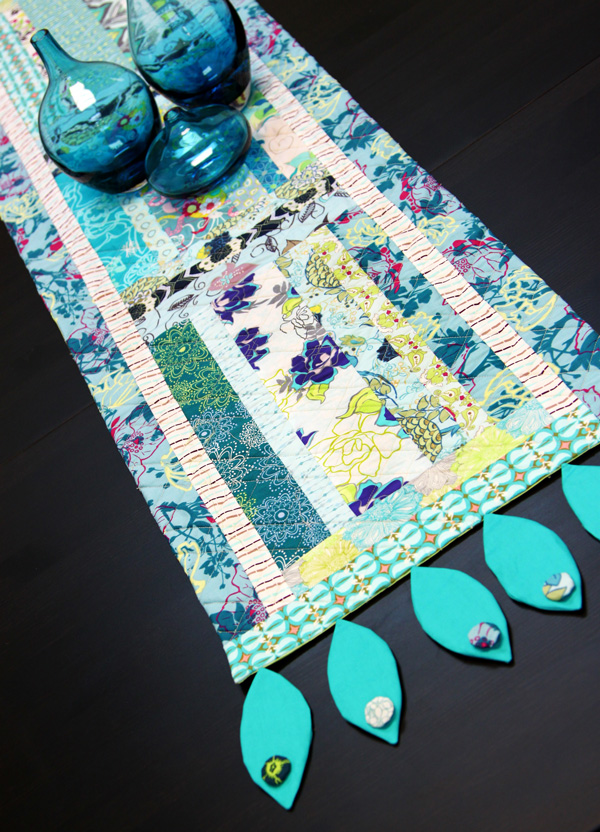
Sometimes a great meal is not about what is on the plate, but what the plate is on, such as Pat Bravo’s Hit the Blues table runner. This beauty is simple to construct and promises to make any meal better—even boxed mac ‘n cheese—just because it’s so gorgeous!
It’s all about the scrappy strips, drawn from several of Pat’s recent collections with Art Gallery Fabrics. The pattern breaks down into three blocks, two strips sets, an extra strip here and there and the borders.
Because none of the fabrics are repeated in the blocks, we’re going to give you the dimensions of the unfinished strips and let you raid your stash. The same holds true for the strip sets. Fat quarters are wide enough to accommodate these strips. Only the long border strips need to be cut from a length of fabric (and you don’t even need much of that).
(Click here to download this pattern—and the templates for the leaves and circles—as a PDF.)
Materials and Supplies
(18) scrappy strips, cut as indicated below, for blocks (none are longer than 16” nor wider than 3 ½”)
(4) scrappy strips for strip sets and inside ends (none are longer than 21” nor wider than 2 ½”)
(2) strips for outer long border cut at 2 ½” x 56 ½”
(2) strips for outer short border cut at 2 ½” x 14 ½”
(2) strips for inner long border cut at 1 ½” x 54 ½”
½” yard solid blue fabric for leaves
Scraps for small circles on leaves (or consider using buttons instead)
Batting at 18” x 60”
Backing at 16 ½ x 58 ½”
Thread for quilting and piecing
Small scrap of template plastic or cardboard
Scrap of fusible, such as Steam-A-Seam or WonderUnder
Instructions
All seam allowances are ¼”.
Blocks:
Two of the blocks are finished at 15” x 10” (Blocks A & B). One is finished at 12” by 10” (Block C). The six strip widths for all three blocks are the same. There are no repeated strips between the three blocks, and that’s how these instructions are written, but you can always make it your way and repeat strips.
1. Cut and sew along strips’ length as follows in the order presented:
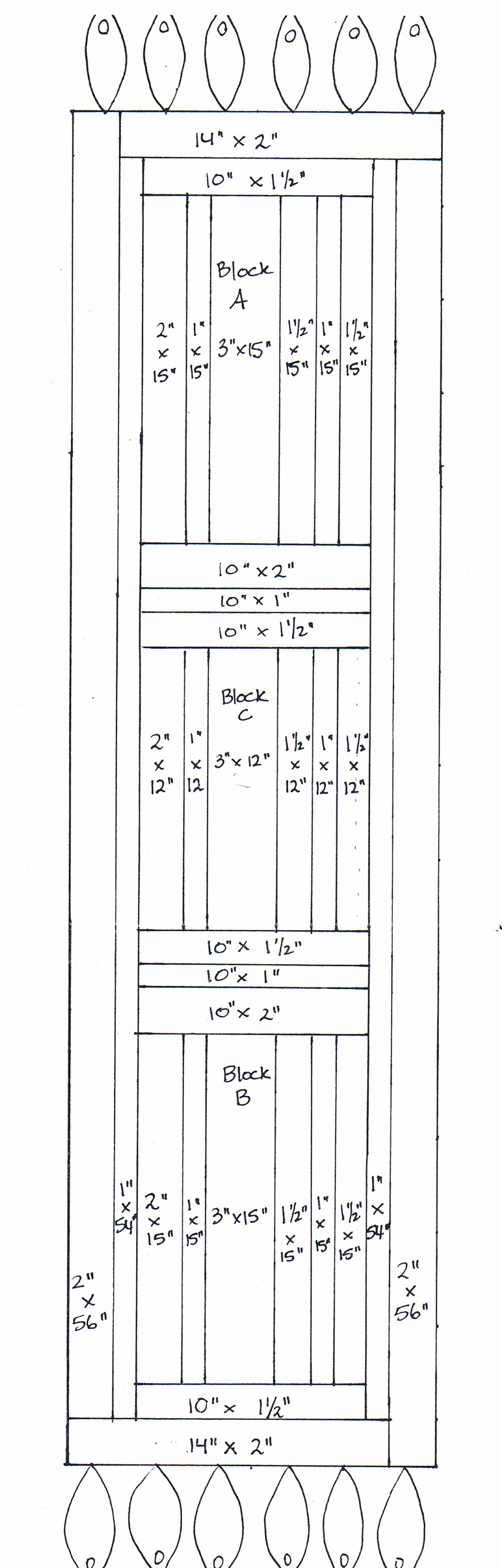 Block A:
2 ½” x 15 ½”
1 ½” x 15 ½”
3 ½” x 15 ½”
2” x 15 ½”
1 ½” x 15 ½”
2” x 15 ½”
Block B:
2 ½” x 15 ½”
1 ½” x 15 ½”
3 ½” x 15 ½”
2” x 15 ½”
1 ½” x 15 ½”
2” x 15 ½”
Block C:
2 ½” x 12 ½”
1 ½” x 12 ½”
3 ½” x 12 ½”
2” x 12 ½”
1 ½” x 12 ½”
2” x 12 ½”
Strip Sets:
1. Cut and sew three strips lengthwise as follows:
2 ½” x 21”
1 ½” x 21”
2” x 21”
2. Cut strip set in half, creating (2) sets at 5” x 10 ½”
Inside Ends:
1. Cut (2) strips at 2” x 10 ½”
Piecing the Runner:
1. From top to bottom sew:
- Inside end
- Block A
- Strip set
- Block C
- Strip set (turned around so it mirrors the first strip set)
- Block B
- Inside end
2. Along long sides, sew (1) inner long border to each side.
3. To join outer borders, sew one long outer border, matching ends at top. Stop within ¼” of bottom of pieced runner’s end, leaving 2 ¾” of strip loose past end of pieced runner. Press open.
4. At runner’s top, sew one short outer border along width of pieced runner. All ends will match up. Press open.
5. On opposite long side, sew other long outer border along length of pieced runner. All ends will match up. Press open.
6. At runner’s bottom, sew one short outer border along width of pieced runner, matching ends at bottom corner. End will extend ¼” past end. Make sure to not catch the first long border’s loose end as you sew. Press open along seam.
7. Fold first long outer border back onto runner top, like when you first sewed strip on. Pin loose bottom end to last short outer border strip. Finish sewing seam line to join last end together. Press open.
8. Press entire top well.
9. To make the pillowcase sandwich, stack in this order: pieced top, right side up; backing fabric, right side facing pieced top; batting. Carefully trim backing/batting with rotary cutter and ruler to match edges of pieced top. Sew ¼” along inside edge of sandwich, leaving about 6” open along one side. Trim or clip corners. When done, gently pull sandwich insides out through 6” opening. Poke corners with sharp tool, being careful not to poke through top. Press sandwich flat, making sure seams are pressed as open as is possible. Press under ¼”seams at 6” opening. Sew edges together, preferably by hand because it’s neater.
10. To quilt table runner: Thread or pin baste layers and quilt as desired. (Note: Pat used a simple cross-hatch design in the pictured example, but almost any design will work here.)
Leaves:
1. Trace leaf onto template plastic.
2. Trace (24) template shapes onto wrong side of solid blue fabric. Template includes ¼” seam allowance. Cut out shapes and pair together (12) sets.
3. Sew along inside edge, leaving 1” open along edge. Trim or clip points, clip along curved edges of seam allowance (careful not to clip past seam allowance) and gently turn right sides out. Press well.
4. Sew just along inside edge, closing 1” opening and finishing leaf.
5. Trace circle onto template plastic.
6. Trace (12) circle shapes onto scraps of fabric. There is no seam allowance needed.
7. Iron fusible to wrong side of scraps. Cut out circles. Remove backing paper and position one circle on one leaf. Iron/fuse into place.
8. If desired, stitch just inside edge of circle.
9. Buttons can be substituted for circles. Sew into place.


{ 4 comments… read them below or add one }
OOOH! I love this!!!!!
I can’t wait to play.
Very nice! Blues are my faves, this would be easy to do from my stash!! Thanks.
this is wonderful! I am making table runners for christmas gifts and this pattern looks easy and fun! thanks for it!
LOVE THIS! Though I don’t have much blue fabric, I do have a LOT of yellow which goes better with my kitchen. I’m gonna do it in yellow/golds (good for the season, too.)